
close
Choose Your Site
Global
Social Media
Views: 110 Author: Site Editor Publish Time: 2026-04-22 Origin: Site


In biomass pellet production, every stage of the process matters. However, the front-end wood chipping stage often determines the efficiency of everything that follows. Shandong BISON MACHINE Co., Ltd., widely recognized as a Best Wood Chipper Manufacturer in the industrial biomass sector, has built its reputation not on marketing claims, but on verifiable engineering choices and documented project outcomes. This article explores some of the most common questions industrial buyers raise when evaluating wood chipper manufacturers for large-scale biomass projects.

Many plant operators focus their evaluation on pellet machines, but the wood chipper deserves equal attention. Chip size uniformity directly affects the load consistency entering hammer mills, the drying efficiency inside rotary drum dryers, and ultimately the density and quality of the finished pellets. When the chipping stage produces irregular or oversized particles, every downstream unit must compensate — and that compensation usually means higher energy consumption, more wear, and lower output quality.
This is why experienced engineers treat the wood chipper as a system-defining piece of equipment rather than a simple pre-processing tool. Selecting the right chipper is, in many cases, selecting the quality standard for the entire line.
BISON engineers the chipper body as a one-piece cast structure rather than a welded assembly. This matters in practice. A welded frame accumulates micro-stress at weld joints under continuous heavy-load vibration. Over time, those stress points cause misalignment and accelerated bearing wear. A one-piece cast body distributes structural stress evenly, maintains tighter tolerances during operation, and significantly extends service life under 24/7 industrial conditions.
Additionally, the reinforced rotor and pressure knife system handles large-diameter logs and irregular wood sections without forcing operators to pre-cut feedstock to narrow size ranges. The pressure knife distributes cutting force more evenly across the rotor shaft and bearings. This design reduces sudden impact loads and keeps chip size output consistent — even when feedstock varies in diameter and hardness.
In terms of scale, the lineup covers power configurations from 110 kW to 315 kW and capacity outputs ranging from 25 m³/h to 250 m³/h. These figures accommodate plants from mid-scale operations to facilities targeting 200,000 tons of annual pellet output.
Feedstock in industrial biomass plants rarely arrives in perfectly uniform dimensions. Round logs from different forest sources vary widely in diameter and hardness. A conventional fixed-speed feeding system handles this poorly — it either jams on oversize material or underfeeds on smaller pieces, disrupting throughput rhythm.
BISON's hydraulic feeding system takes a different approach. It automatically adjusts feeding speed based on real-time material load. When the system detects a harder or larger piece entering the cutting zone, it slows the feed to match the chipper's processing capacity. A plunger-type hydraulic buffer cylinder absorbs the sudden impact forces that come with irregular feedstock. This cushioning mechanism protects the rotor shaft and bearings from shock loading that would otherwise shorten their service life considerably.
The 5-meter high-strength chain plate conveyor, equipped with dense traction wheels, maintains continuous material supply across these variable feeding conditions. Together, these features allow stable, high-capacity chipping without frequent operator intervention or unplanned shutdowns — a critical factor for plants running continuous shifts.
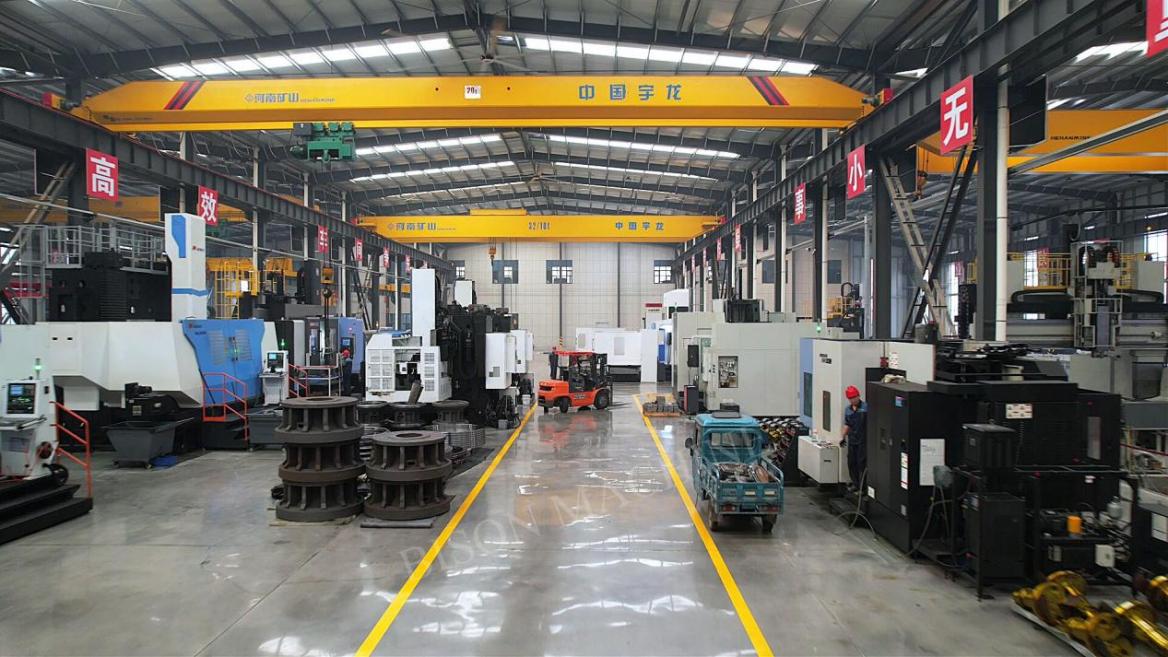
Founded in 1998, BISON MACHINE operates four modern factories covering a combined area of 96,000 square meters, with total investment exceeding 100 million RMB. The facilities run advanced CNC machining centers, laser cutting systems, and a dedicated quality inspection center that independently evaluates raw materials, key components, and final assemblies before delivery.
In 2018, the company invested in Japanese SNK five-axis gantry machining centers and Korean DOOSAN CNC horizontal machining systems. In 2025, this investment expanded further to include Italian PAMA, Italian DAVI, German KUKA, and Japanese FANUC equipment. These are not incidental upgrades. They represent a sustained manufacturing strategy that keeps dimensional tolerances tight and component performance predictable across production batches.
BISON holds 43 proprietary patents and carries ISO 9001, CE, and SGS certifications. The company holds recognition as a National High-Tech Enterprise and a Provincial Technology Center. These credentials reflect a verifiable commitment to engineering standards rather than general marketing language.
A wood chipper operates most effectively when engineers design it as part of a coherent process chain rather than as an isolated machine.In a typical large-log processing line, chipped output first enters rotary drum dryers to reduce moisture to the target level. The dried material then feeds into hammer mills for secondary size reduction, before moving to pellet machines for densification and finally passing through cooling and packing systems.
BISON's 200,000-ton annual biomass pellet production line case illustrates this integration clearly. That configuration pairs one wood chipper with one hammer mill, one rotary screen, one rotary drum dryer, six pellet machines, one cooling unit, and two packing scales — all working as a calibrated system. Each equipment selection connects to the capacity and output specification of the stage that follows it.
This systems-level thinking extends to project planning. BISON engineers analyze raw material characteristics, moisture content, target capacity, and site layout before finalizing any equipment configuration. The result is a production flow designed for stable throughput rather than theoretical peak numbers.

Equipment performance over a multi-year production lifecycle depends heavily on what happens after installation. BISON's service scope covers the full project timeline — from pre-project material analysis and process layout design, through factory inspection, on-site installation guidance, and commissioning parameter adjustment, to operator training, maintenance guidance, and long-term remote technical support.
Operators receive training on equipment structure, daily start-up procedures, routine maintenance standards, and common fault diagnosis. This knowledge transfer reduces unplanned downtime and lowers dependence on external service calls. Spare parts availability and on-site technical service provide additional assurance for plants running demanding production schedules.
To date, BISON has delivered over 500 biomass pellet production lines across Asia, Europe, South America, and Africa. That track record across diverse operating environments — different feedstocks, climates, and regulatory contexts — reflects the kind of field-tested reliability that project investors and plant managers look for.
For industrial biomass facilities evaluating front-end equipment, the wood chipper represents a decision point that shapes production quality from the first stage onward. BISON MACHINE(SHANDONG BISON MACHINE CO., LTD.)'s engineering approach, manufacturing infrastructure, and full-lifecycle service model address that decision with measurable substance.
For more information on customized biomass solutions and industrial pellet technology, please feel free to contact us.


